

When the stars went dark, brute force did not save civilization. Knowledge did. The archives that crossed the portals. The laboratories that kept running in the void. Science did not stop when the universe collapsed — it became more urgent than ever.
In Nexus: Downfall, the research system is the silent engine driving every strategic decision. For the closed alpha, it launches with 148 technologies across 7 research trees — and we expect to reach around 200 during Early Access. Every choice you make in this system defines the fate of your colony.
Today I am walking you through the seven trees, what you can unlock in each one, and how to chart your scientific path in the new universe.
How research works
The core is simple: build Research Centers on your planets, assign workers, and generate Science Points (SP). The higher the level of your Centers, the faster you accumulate points. Technologies, laws, scientist cards, and diplomacy pacts can all boost your output further.
You can only research one technology at a time, so choosing the right order matters. The cost is paid exclusively in SP — not in raw materials — which means even a mineral-poor colony can become a scientific powerhouse if it prioritizes its labs. Unlike other games, technologies here are not an endless treadmill of level ups: each technology unlocks something different and opens new paths as you advance.
The 7 research trees
Each tree has its own unlock requirements and a clear purpose. Here is what you will find inside each one:
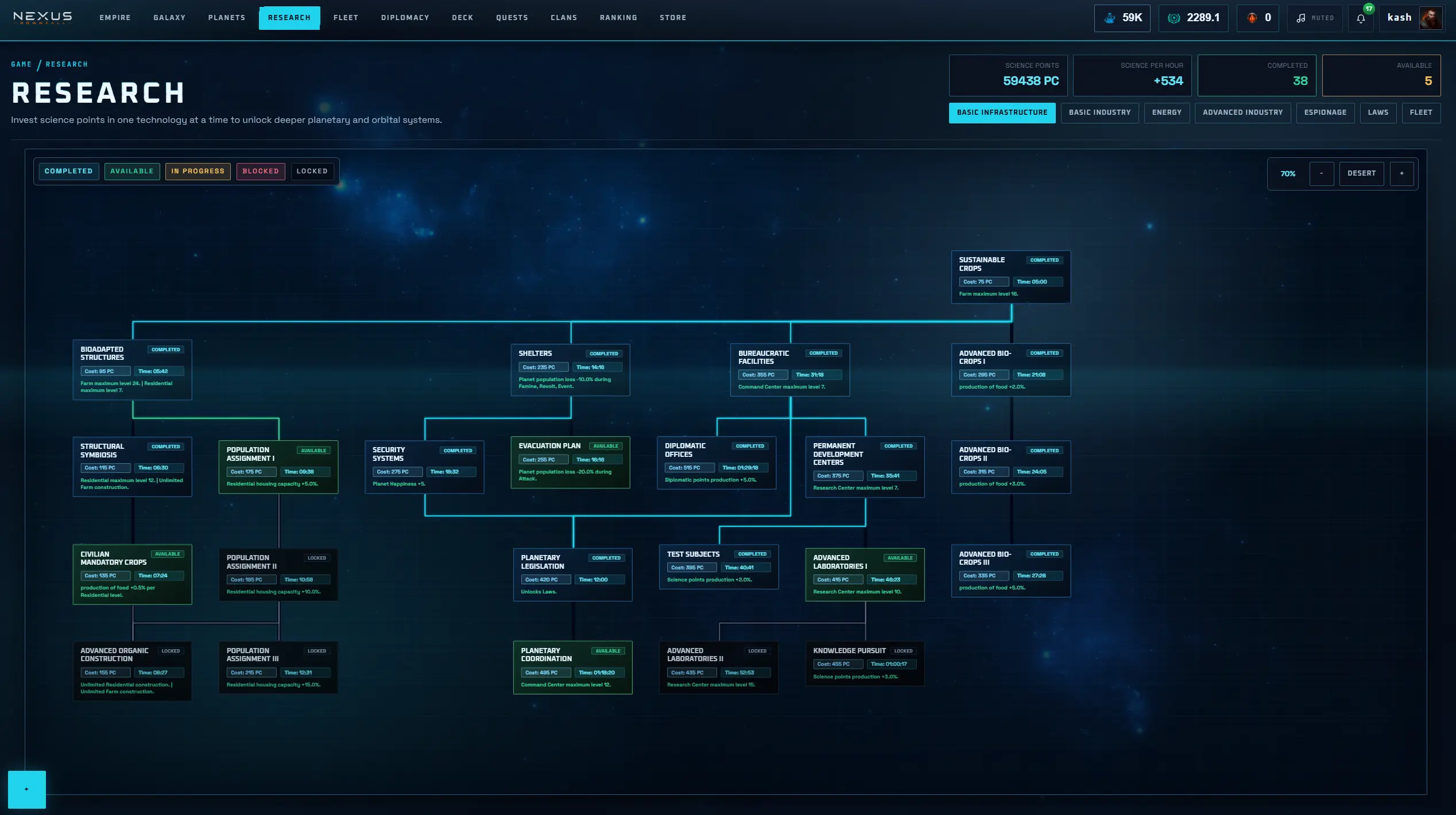
Basic Infrastructure
The foundation of your colony. This will likely be the first tree you start researching — though you can always switch between technologies from different trees. It improves food production, housing capacity, planetary happiness, and SP generation. You will unlock upgrades for Research Centers and the Command Center, plus the critical Planetary Legislation tech that opens the Laws tree. If you want your colony to grow and stay happy, start here.
Basic Industry
The economic backbone. Optimizes extraction of minerals, microchips, and hydrogen. Introduces mine specializations and technologies that reduce workers and construction costs. The crown jewel: Planetary Mantle Exploitation, which removes building limits on all three basic extraction structures — letting you scale your economy without constraints.
Energy
From basic generators to nuclear fusion reactors. Every building needs power, and this tree ensures you never run out. Energy improvements stack with each other, and the tree culminates with unlimited construction of Power Plants and Nuclear Reactors. A quiet tree, but neglect it and your planet will grind to a halt.
Advanced Industry
This is where the fun begins. Planetary defense upgrades, shipyard expansion, and the futuristic asteroid mining unlock. This tree also gives you access to advanced components needed to build the most powerful ships in the game. It bridges your ground economy with your orbital ambitions.
Espionage
The smallest tree in the alpha — but do not underestimate its future. For now, this tree lets you research espionage probes to gather intel on your rivals before striking. In the future, it will unlock infiltration missions, subterfuge operations, and ways to improve your effectiveness at them.
Developer's note: this tree is going to grow significantly. The current technologies are the foundation for a full system of infiltration, counterintelligence, and covert missions coming in future updates. We expect this tree to reach 15 to 20 technologies before version 1.0.
Laws
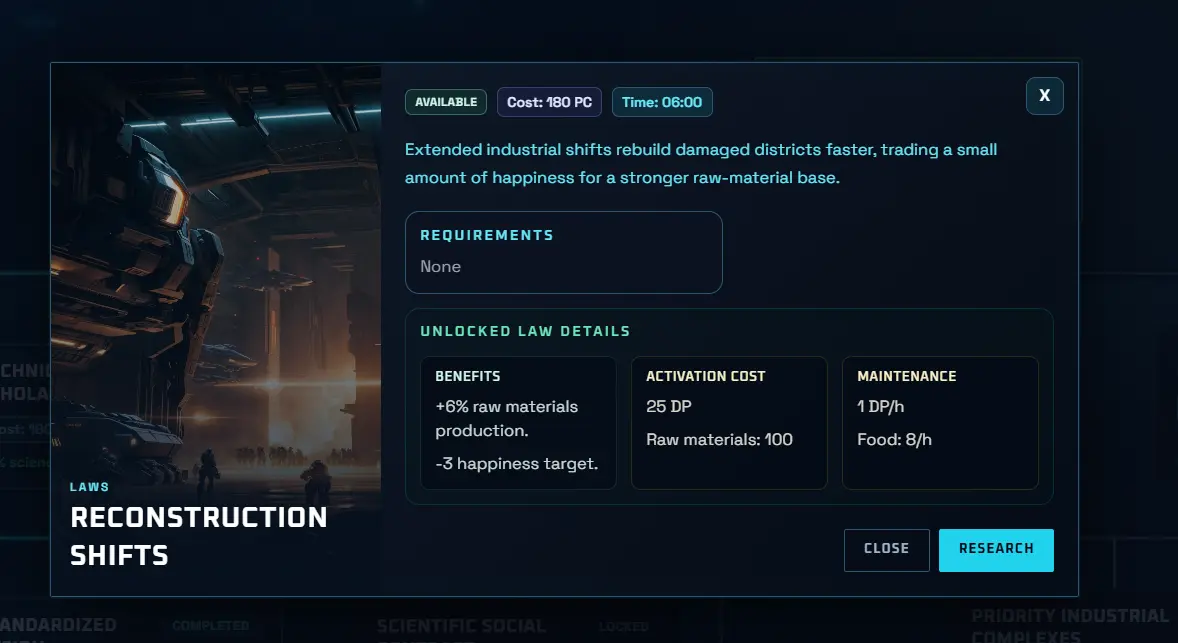
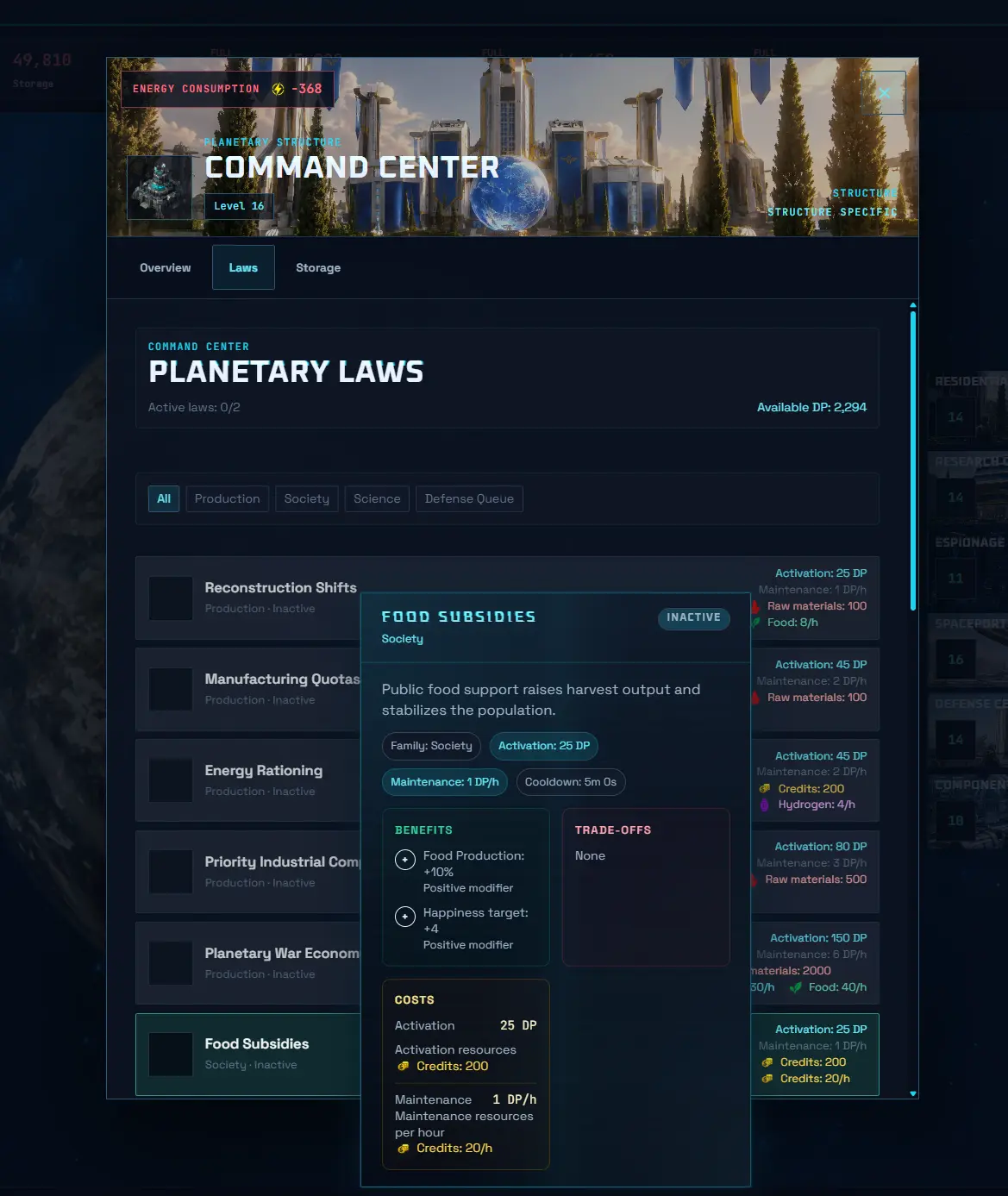
This is the tree where you unlock the laws you will enforce across your domains. Laws do not give passive bonuses: each research project unlocks a planetary law or imperial edict that you must actively choose to enforce. You can have up to two laws and two edicts active simultaneously. Laws apply at the planetary level, while edicts affect all your planets.
Laws are decisions with consequences. Planetary War Economy boosts your raw materials and microchips but reduces happiness and science output. Colonial Welfare Program makes your people happier and better fed, at the cost of slower construction. Every law you enact defines what kind of ruler you are.
Fleet
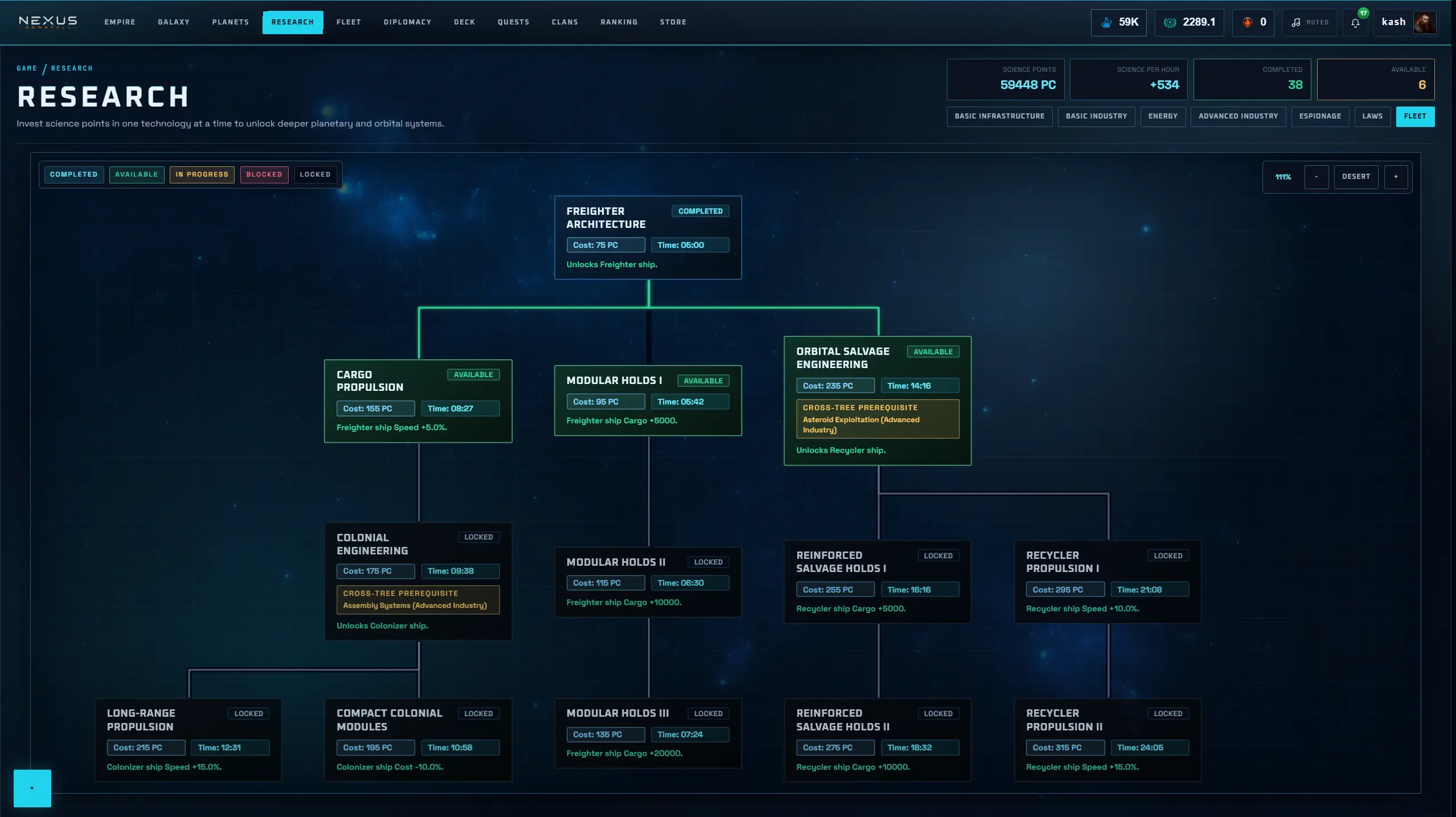
The largest tree and the one war-focused commanders obsess over most. Unlocks every ship — from the humble Freighter to the imposing Leviathan — and improves their combat stats. Technologies like Fire Control, Naval Armor, and Advanced Deflectors boost your fleet's capabilities, while MPD propulsion upgrades cut fuel consumption across your entire navy.
Endgame Fleet technologies take serious investment — we are talking tens of hours and massive SP costs — but they are what separate a galactic power from a forgotten colony.
Dependencies and choices
Technologies are connected in a dependency graph. Arrows show what you need within a tree, and some technologies require unlocks from completely different trees. The interface clearly shows what requirements you must meet to research each specific technology.
Costs and pacing
Each tree has its own rhythm. Basic Infrastructure technologies start quick and cheap — a few minutes and under 100 SP. Fleet technologies start the same way, but the final ones demand patience: tens of hours and massive point investments. Laws scale from modest decisions to empire-defining choices costing over 2,000 SP.
If the wait becomes unbearable, there are research consumables: rare items that slash the remaining time on your active research — and no, they will not be sold for real money. Additionally, research diplomacy pacts let allied players share the burden, reducing costs and time for both sides.
What is coming
The 148 technologies shipping with the closed alpha are just the beginning. We expect to reach around 200 technologies during Early Access, with the biggest expansion coming to the Espionage tree — infiltration missions, counterintelligence networks, and covert operations that will add an entirely new layer to galactic politics.
There are also more technology trees planned for completely new mechanics, and we are always listening to our community for ideas.
The Nexus: Downfall research system is designed so that no two commanders follow the same path. Your civilization, your faction, and your playstyle define what you prioritize. And in a persistent universe, your scientific decisions leave a permanent mark on the galaxy.
See how research fits into the wider genre in our guide to persistent browser space strategy.
The closed alpha is complete. Join the newsletter for the research-system retrospective and Early Access updates targeted for October 1, 2026.
The frontier is not conquered with fleets alone. It is conquered with knowledge.
— The Nexus: Downfall team
Join the newsletter for Early Access
The closed alpha has ended. Join the newsletter for the retrospective and Early Access updates targeted for October 1, 2026.
Join the newsletter